
ਇਹ ਲੇਖ ਪੰਜਾਬੀ ਵਿੱਚ ਪੜ੍ਹੋ (Google Translate)
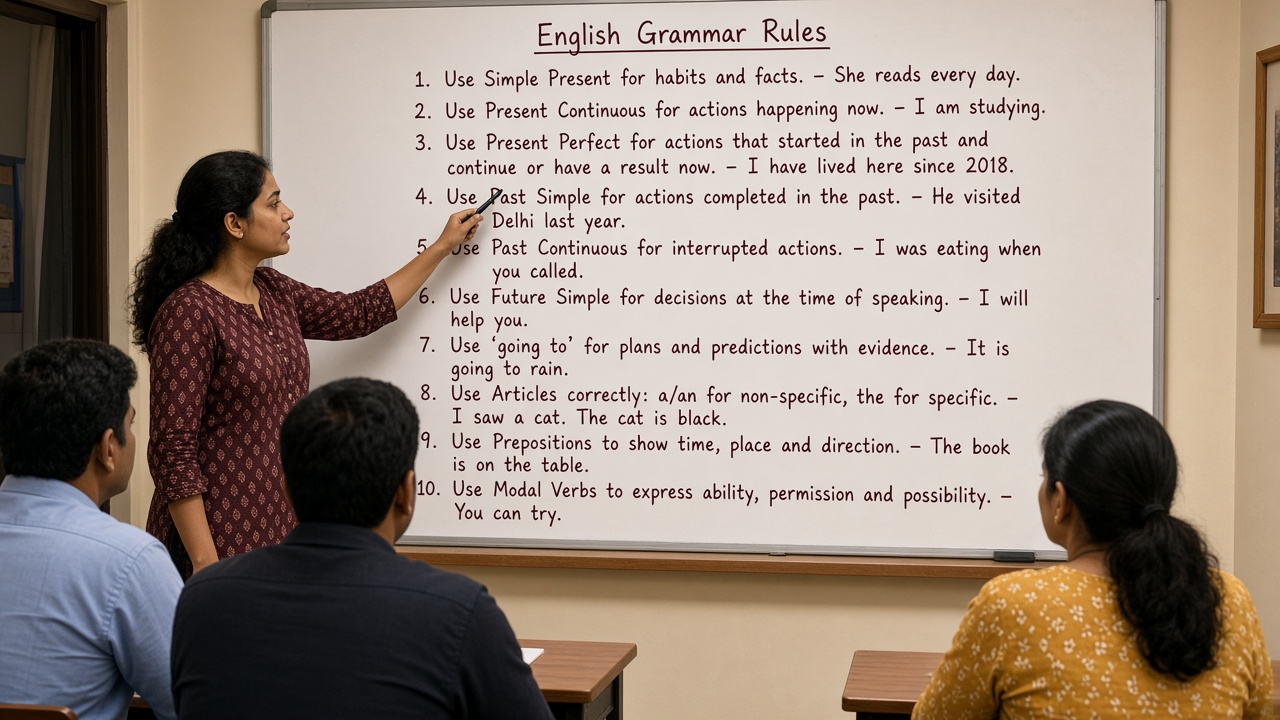
Grammar for speaking is not a school exam on clause types. It is the small machinery that keeps sentences standing while you talk. We teach these ten rules in English Grammar Lessons and then force them into speech in Spoken English so they survive interviews and classes.
Say each example aloud. If you only read, you will still say the old form tomorrow.
Rules 1–5: time and verbs
- Present simple for habits: “I take the 8:10 bus.”
- Present continuous for now: “I am waiting for the trainer.”
- Past simple for finished time: “I joined the batch in March.”
- Present perfect for life up to now: “I have taken two mock tests.”
- Going to / will: plan vs instant decision – “I am going to sit PTE in December.” / “I will send the form now.”
Rules 6–10: the glue
If a rule is new, do not collect ten more PDFs. Record five sentences with that rule today. That is grammar for speaking.
- Questions need an auxiliary: “Where do you work?” not “Where you work?”
- Articles: a/an for one of many, the for specific – “I am a teacher. The class starts at six.”
- He/she + -s: “She lives in Pinjore.”
- There is / there are: “There are two rooms.”
- Irregular pasts you actually need: go–went, take–took, write–wrote, speak–spoke, leave–left.
Why ten, not fifty
Spoken grammar fails in a few tunnels: time, questions, articles, agreement. Fifty rules in a week produces highlighting. Ten rules in a month produce sentences. We would rather hear “Yesterday I went” one hundred times than hear a passive-voice lecture you cannot use in a shop.
When a tenth rule is clean, we add the next from English Grammar Lessons. The order is not a secret exam; it is the order of damage in our recordings.
A rule meets a story
Take present perfect. Tell the story of your English: “I have studied on Sundays. I have not sat a mock yet. I have been late twice this week.” That is grammar attached to a life. Isolated gap-fills do not stick in the mouth. Attach every rule to a story about this week, then say it to the recorder.
A seven-day speaking log (keep it ugly)
Conversation improves when you can point at files, not at intentions. Create a folder on your phone named this week’s date. Each day add one recording, even if it is ninety seconds.
- Mon: routine (present simple).
- Tue: yesterday (past simple).
- Wed: a person you met.
- Thu: an opinion with “because” and an example.
- Fri: shadow 90 seconds of clear audio, then a one-minute talk on the same topic.
- Sat: longer two-minute talk; repair five sentences.
- Sun: listen to Monday vs Saturday. Circle one grammar leak. That leak is next week’s rule.
Bring one file to Spoken English class. Ask for five repairs, not “was it good?” If you cannot attend, send nothing – still do the folder. Fluency is retrieval at home. Class is pressure and correction. Grammar lessons and vocabulary pages on this site support the folder; they do not replace it. When two-minute talks are stable for ten days, you may look at an IELTS or PTE mock. Until then, a mock is an expensive way to learn that you still translate every sentence. We will not pretend a beginner recording is an official English level certificate.
Families: one listener, one job (“Did she use yesterday correctly?”). A committee of six critics will end the week. Put the recorder away if a fight starts; return after tea. The point is a year of speech, not a perfect Sunday.
One-rule recording
Choose rule 7 (articles). Describe your kitchen for one minute, forcing a/an/the. Play back and tick missing articles. Repeat once.
Next step. English Grammar Lessons for explanations, Spoken English to use them, speaking prompts for extra topics.
Frequently asked questions
Should I study all 12 tenses?
Master the five time rules above first. Rare tenses can wait until you can talk about yesterday and next week cleanly.
Will IELTS punish every article error?
Repeated article errors lower the grammar band. Occasional slips with otherwise clear speech are different from errors in every sentence.
Can I skip grammar if I am fluent?
Fluency with broken tense still confuses listeners and examiners. Repair the high-frequency rules.
Hindi grammar – does it help?
A little, for concepts. English articles and auxiliaries still have to be practised in English sentences.