
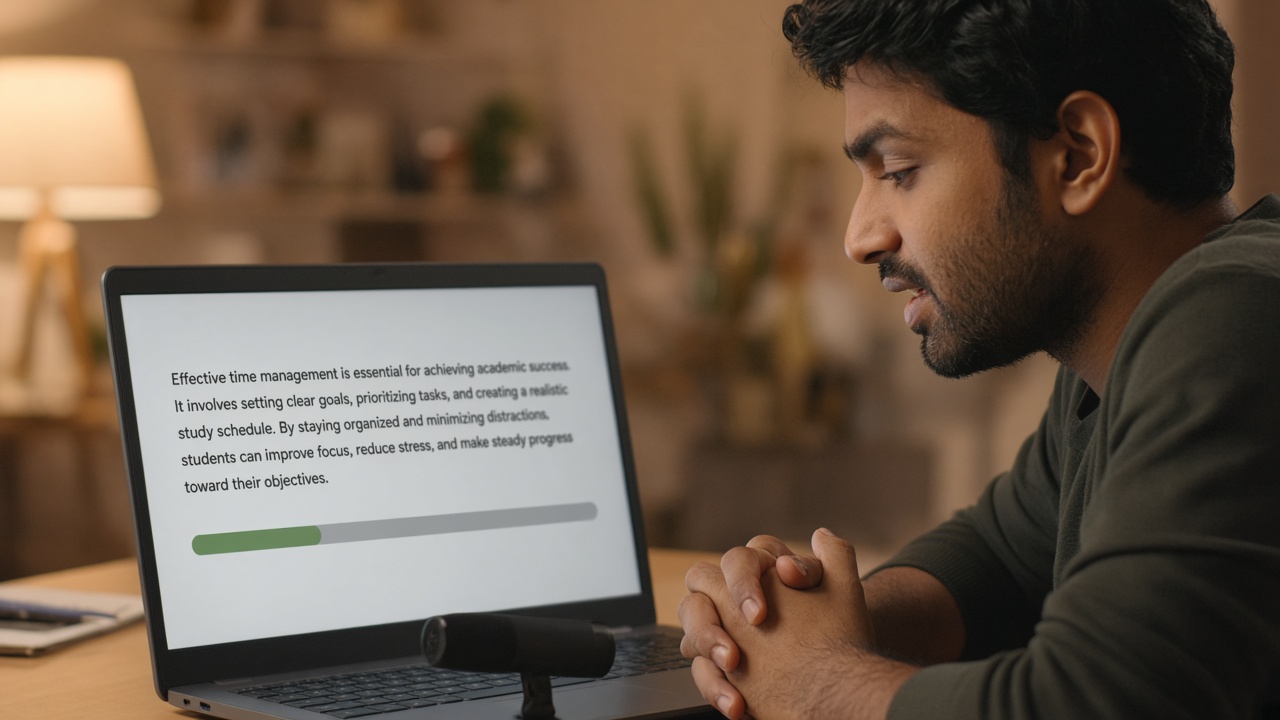
PTE Read Aloud looks easy: a paragraph appears, a short prep bar runs, then you speak until the recording ends. Candidates still rush, start late, swallow word endings, or speak in a flat list. Because the task contributes to both speaking and reading, those habits hurt two scores at once.
This is the Read Aloud method we use in PTE Preparation Online. Use it on class items, then on a full PTE paper from English Mock Test. Mock marks remain practice estimates, not Pearson scores.
Format in one minute
You get a short time to look at the text (the prep bar). When the recording begins, speak the paragraph clearly. You cannot re-record. If you finish too early, wait quietly. If you finish too late, the mic cuts you. Do not comment on the text (“this is about pollution”) – read the words on the screen.
What to do in the prep seconds
Do not try to understand the whole academic idea. Mark stress: underline content words (nouns, verbs, numbers). Put a tiny slash where you will breathe – usually after commas and before “which” or “because.” Whisper the first six words so the opening is automatic.
If a word is unknown, decide a simple pronunciation now. Hesitating for three seconds on “photosynthesis” costs more than a slightly off vowel.
During the recording
Start as soon as the beep allows – empty silence is not “thinking time” once recording has begun. Keep a steady pace, not a race. Finish consonant sounds: “and,” “report,” “development.” If you stumble, continue from the next word; do not restart the whole sentence unless you are still on the first line and it costs less than a full restart.
Sample opening: “Recent studies / on urban transport / suggest that short bus lanes / can reduce peak delays.” Breathe at the slashes. Stress studies, transport, bus lanes, delays.
Practice that actually transfers
Read news paragraphs silently, then aloud, then to a timer. Record six items a day for a week. Listen only for: late start, missing endings, panic speed. Do not obsess about a British vs Indian accent. Clarity and completeness score; a forced accent usually makes you slower.
How we mark a Read Aloud in class
We listen once and tick only three boxes: started on time, finished inside the bar, endings audible. We do not begin with accent coaching. A student who starts two seconds late and drops every plural will not be saved by a prettier vowel. Fix the three boxes for a week. Then we talk about /θ/ or word stress if the recording is still hard to follow.
If you practise only in your head, you will not hear the late start. The phone recording is the teacher when we are not in the room. Put six takes in a folder named by date. That folder is homework.
Linking Read Aloud to the rest of PTE
After six Read Alouds, do five Repeat Sentences. The mouth is already warm; memory tasks land better. Then one Describe Image so you switch from reading print to generating speech. That 20-minute stack matches the exam’s demand better than an hour of silent vocabulary. Full stacks belong before a PTE mock so the mock is a test, not a first meeting with the mic.
A five-day PTE task rotation
PTE rewards stacks of short tasks. Copy this rotation in the week you are working on the skill in this article. Use a laptop and a microphone every day, not a phone keyboard.
- Day 1: 10 Read Aloud + 10 Repeat Sentence. Tick late starts.
- Day 2: 10 Write from Dictation + 5 minutes of typing repaired sentences.
- Day 3: 6 Describe Image + one 20-minute essay plan and type.
- Day 4: listening items only (highlight / multiple choice / summarise spoken text) under one-play rules.
- Day 5: a mixed 40-minute set in exam order, then a log of the three worst tasks.
Integrated scoring means a lazy Repeat Sentence week also hits listening. Do not “only speak in class” and hope Pearson will understand. Class at Shree Academy is for a trainer to hear the beep, the ending consonants, and the panic pause. Homework is for volume. When the log shows the same three tasks for two weeks, those three tasks are your next mock’s story – sit PTE Academic or Core from the English Mock Test page, matching the name on your visa or university letter. The slip is a Shree Academy estimate, not a Pearson report. Do not send it to a university.
If your throat is tired, swap Day 3 images for extra dictation rather than whispering Read Aloud. Whispered speaking trains a score you will not get on a real microphone.
Six-item Read Aloud set
Find six sentences of 40–60 words (class worksheet or a mock item). For each: 30 seconds prep with slashes, then one recorded take. No second take. After all six, listen once and tick late-start / missing ending / too fast.
Next step. Put Read Aloud into a full speaking block on PTE Preparation Online, then sit a PTE Academic mock via English Mock Test.
Frequently asked questions
Should I read very fast to finish?
No. A clear, complete reading beats a rushed one that drops endings. Pace so you finish inside the bar without sprinting.
Can I have a slight Indian accent?
Yes. Examiners (and scoring engines) need to understand you. Do not add an accent you cannot control under pressure.
What if I cough?
Pause, continue. Do not apologise at length. The task is the paragraph, not a conversation.
Does Read Aloud affect reading score?
It contributes to speaking and reading. That is why we will not skip it even if you “only worry about listening.”