
ਇਹ ਲੇਖ ਪੰਜਾਬੀ ਵਿੱਚ ਪੜ੍ਹੋ (Google Translate)
Part 2 of IELTS Speaking looks generous until you sit there with a pencil and a brain full of Hindi. The card gives prompts. Your job is to turn them into a two-minute talk with a beginning and an ending. Memorised stories that do not match the card are obvious and risky.
This is the note-and-speak method from IELTS Preparation Online. Everyday fluency still comes from Spoken English. Full tests: English Mock Test.
The one-minute note
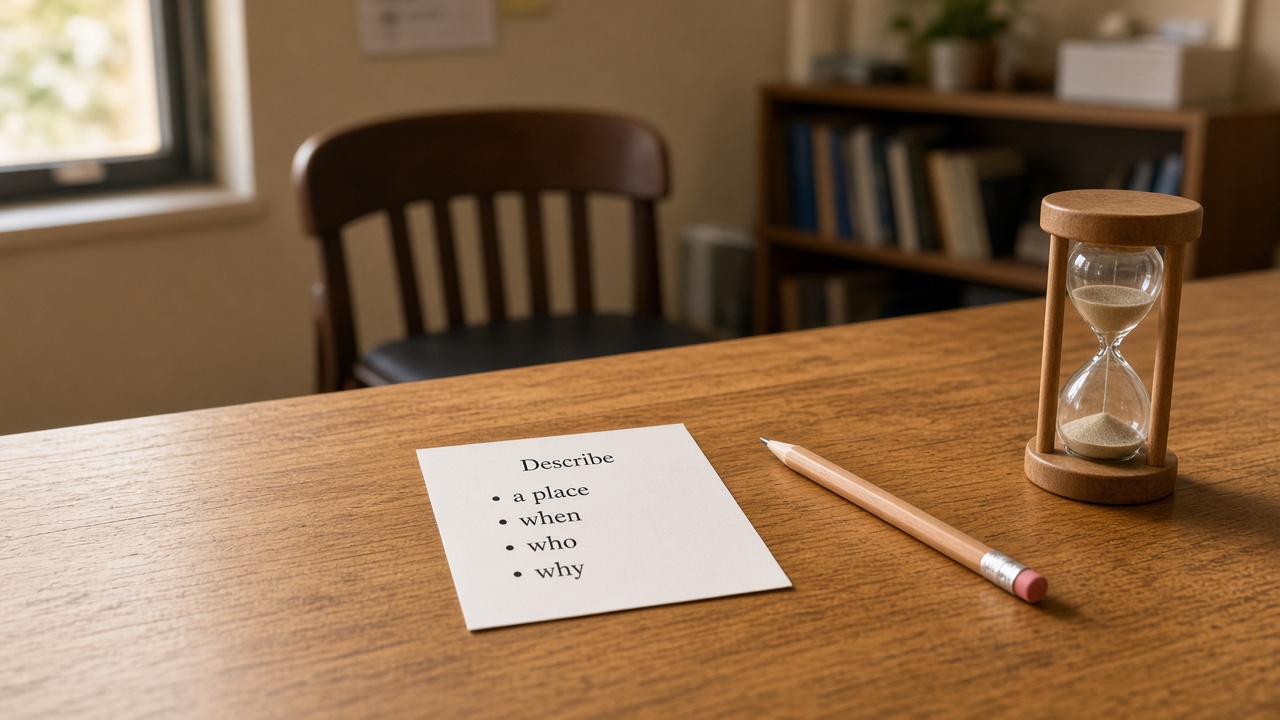
Write five words: topic, when, who, what happened, why it mattered. Not sentences. If the card says “describe a book,” write the title, last year, cousin, borrowed, ending. Glance at the card while you speak; it is allowed.
The two-minute shape
0:00–0:20 opening frame. 0:20–1:20 story (when, who, what). 1:20–1:50 why it mattered / how you felt. 1:50–2:00 close: “That is why I still remember it.” If the examiner stops you, you were in time. If you stop at 0:50, you under-performed.
“I am going to talk about a train journey to Kalka last winter. I went with my sister… We missed a connection… The tea stall was packed… I learnt to leave earlier. That is why I still check the timetable twice.”
If the topic is unfamiliar
Borrow a nearby true story. If you have not “visited a museum,” talk about a school trip or a fort you did visit. Do not invent a Harvard library. Examiners can ask Part 3 follow-ups; lies collapse.
Language while you talk
Past tenses for past cards. “Used to” for habits. If you slip, repair once: “sorry, I went – not go.” Then continue. Fluency marks like forward motion.
Notes that fit on a ticket
If your notes look like an essay, you will read them and lose fluency. Five words. We physically limit paper in class: a sticky note. If it does not fit, you are writing sentences. The card is already a list; your notes are only memory hooks.
Practise once this week with no notes at all after the minute, and once with the sticky note. You should survive both. Test day notes are a backup, not a script.
When the card is about something you dislike
You may still talk. “I am not a football fan, but I will describe a match I had to watch with my brother…” is honest and long enough. Refusing the topic is not an option. We throw awkward cards on purpose in IELTS labs so the first awkward card is not the real one.
An eight-day IELTS microcycle you can copy
Use this when the article’s skill is your weak one. Keep the other skills alive with twenty minutes, not another abandoned timetable.
- Day 1: 30 minutes on the skill in this article, timed, no phone.
- Day 2: same skill + 20 minutes Listening (one play only).
- Day 3: Writing Task 2 plan in 12 minutes, or Task 1 if Academic charts are the leak.
- Day 4: Speaking Parts 1 and 2 recorded; repair five sentences.
- Day 5: Reading – one passage with a 60-second map first.
- Day 6: mix the weak skill with a short mock section, not a full paper.
- Day 7: rest the exam brain; ten minutes of spelling or frames only.
- Day 8: repeat Day 1 and compare the recording or the error tally. If nothing moved, change the drill, not only the number of hours.
Working learners should not stack this on top of a full-time job and a six-hour YouTube binge. Cut the binge. Keep the eight days. Shree Academy batches (online and Kalka) exist so Days 4 and 5 have a human listener, but the other days still belong to you. When two microcycles are clean, sit a full paper from the English Mock Test hub and review the same afternoon. Portal bands are practice estimates, never an official IELTS result.
Write the eight days on paper, including the clock time you will actually sit down. A plan that starts “after I feel motivated” does not start. If a festival or night shift destroys two days, skip to the next number; do not hold a funeral for the timetable.
Three cards this week
A person, a place, an object. One minute notes, two minutes recorded, no second take the same day. Next day, repeat only the card that finished under 1:20.
Next step. Cue-card labs in IELTS Preparation Online. Daily speaking: English Speaking Practice.
Frequently asked questions
Can I look at my notes?
Yes. Notes are for you. Do not read a written essay.
What if I hate the topic?
You still have to talk. Find one true angle and go. There is no alternative card in the real test.
Should I use idioms?
Only ones you say naturally. A forced “it was a blessing in disguise” every card sounds learnt.
Computer-delivered speaking?
You still get prep time and a two-minute record. Practise with a timer and a mic, not only with a smiling teacher.