
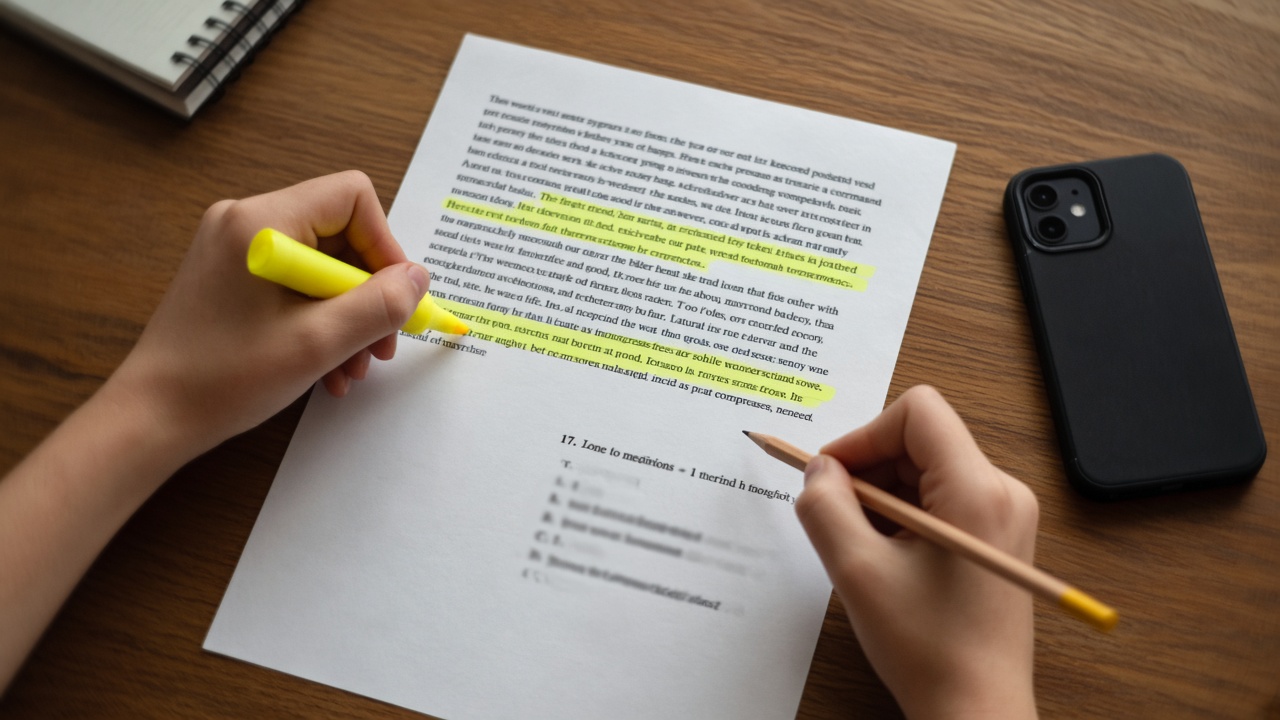
Candidates try to understand every Academic passage as if it were a novel. Then they have twelve minutes left for ten questions. IELTS Reading pays you for locating answers. Understanding the author’s childhood can wait until you have finished the True/False/Not Given set.
This is the search method we use in IELTS Preparation Online. GT passages are shorter and more practical, but the search skills are the same. Timed full papers live on English Mock Test.
Sixty-second map
Before questions, skim titles, first sentences of paragraphs, and any names/dates. You are building a map: Paragraph B is about costs, D is about a study in 2018. Then look at question 14. You now know where to scan.
Scan for a token, then read a window
Tokens: names, numbers, unusual nouns from the question. Find the token, then read one sentence before and two after. The answer is usually in that window. If you start reading from line 1 every time, you will not finish.
True / False / Not Given without philosophy
True: the passage says the same. False: the passage says the opposite. Not Given: the passage does not decide. “Not Given” is not “I am not sure.” If the passage never mentions the price of tickets, you cannot mark False. Do not argue with the text using world knowledge.
Guess with a flag, do not camp
If a question costs more than 90 seconds, flag it, guess, move. Come back if time remains. Accuracy includes finishing the paper. Ten blank answers cannot be correct.
What “Not Given” fights look like
A question says the researcher lived in London. The passage says the study was published in London. Students mark True because they saw the word London. That is world-building, not reading. Not Given is the adult answer when the passage never states the claim. We practise by covering the question and asking: “Does the text decide this, contradict this, or stay silent?” Silence is Not Given.
Do this on five questions, slowly, then speed up. Speed without this distinction is just faster guessing.
GT readers: do not get casual
Notices and workplace texts still hide True/False traps. Time yourself. A sofa-read of a leaflet is not GT Reading. Use the same search method as Academic, with slightly different passage flavour. Confirm your module on IELTS Preparation Online so you are not mapping the wrong book.
An eight-day IELTS microcycle you can copy
Use this when the article’s skill is your weak one. Keep the other skills alive with twenty minutes, not another abandoned timetable.
- Day 1: 30 minutes on the skill in this article, timed, no phone.
- Day 2: same skill + 20 minutes Listening (one play only).
- Day 3: Writing Task 2 plan in 12 minutes, or Task 1 if Academic charts are the leak.
- Day 4: Speaking Parts 1 and 2 recorded; repair five sentences.
- Day 5: Reading – one passage with a 60-second map first.
- Day 6: mix the weak skill with a short mock section, not a full paper.
- Day 7: rest the exam brain; ten minutes of spelling or frames only.
- Day 8: repeat Day 1 and compare the recording or the error tally. If nothing moved, change the drill, not only the number of hours.
Working learners should not stack this on top of a full-time job and a six-hour YouTube binge. Cut the binge. Keep the eight days. Shree Academy batches (online and Kalka) exist so Days 4 and 5 have a human listener, but the other days still belong to you. When two microcycles are clean, sit a full paper from the English Mock Test hub and review the same afternoon. Portal bands are practice estimates, never an official IELTS result.
Write the eight days on paper, including the clock time you will actually sit down. A plan that starts “after I feel motivated” does not start. If a festival or night shift destroys two days, skip to the next number; do not hold a funeral for the timetable.
One passage, two clocks
- 60 seconds: map only.
- 12 minutes: questions (Academic) or the matching GT section time.
- Count unanswered items. That number is your first enemy, before “hard vocabulary.”
Next step. Reading strategy in IELTS Preparation Online. Full timed paper: English Mock Test.
Frequently asked questions
Should I read the questions first?
A 60-second map, then questions, works well. Reading all questions in detail before any map can overload you. Try both in class and keep the faster method.
What about unknown words?
Skip them unless they sit on the answer. You rarely need every adjective.
GT vs Academic reading
GT uses more everyday texts. Still time yourself. Do not treat GT as casual reading on the sofa.
Can I write on the question paper?
On paper tests, yes – underline tokens. On computer, use highlighting tools. The answer still has to go in the correct box.