
यह लेख हिन्दी में पढ़ें (Google Translate)
“How long to prepare for IELTS?” has an honest answer: it depends on your starting English and your target band. A student who already speaks in class for two minutes and reads the news will not need the same calendar as someone who still translates every sentence. Marketing that promises a band 7 in ten days usually sells panic, not a plan.
Below is the planning method we use in IELTS Preparation Online. Pair it with a diagnostic mock from English Mock Test – remembering those scores are practice estimates, not official IELTS.
Start with a diagnostic, not a dream date
Sit one timed paper or a sectional set before you buy a plane ticket. If Listening is 5.5 and you need 7, you are not “a month of tips” away. If you cannot finish Speaking Part 2, add Spoken English weeks before you live in exam papers.
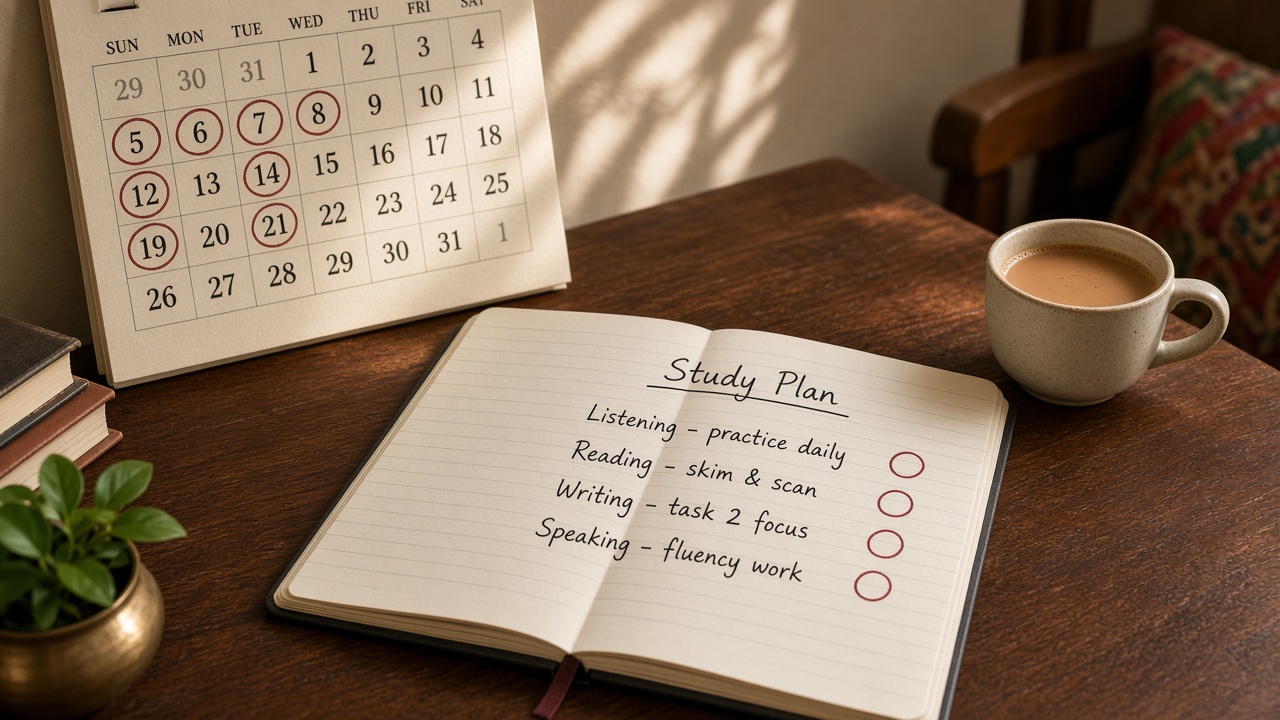
A realistic 8-week sketch (already functional English)
Weeks 1–2: task types, one skill a day, no full mock except the diagnostic. Weeks 3–5: two skills a day plus one weekly timed Writing. Week 6: first full mock, 45-minute review. Week 7: leak-focused drills. Week 8: second mock, light review, sleep. Working learners: 10–12 hours a week. If you only have five hours, stretch to 12 weeks rather than skipping review.
If your English is still building
Add a Spoken English block first. Exam strategy on top of silence does not hold. Vocabulary and grammar go into speaking the same day – see our conversation and grammar articles – not into a separate forever-course with no output.
Book the test when the plan has evidence
Evidence: two writings in 40 minutes, Listening with one play, a Part 2 that lasts two minutes. Then book. Booking first and hoping adrenaline will teach Reading is how people pay for a second test.
Hours, not slogans
A shopkeeper who can give 45 minutes after closing is not a college student with four empty hours. We write the hours first, then the week plan. If the hours cannot carry two skills a day, we drop to one skill plus a short speaking recording. The exam date moves. The sleep does not. Tired Listening is fake Listening.
Counselling exists to say this out loud when a relative has already booked a date as a surprise. Bring the booking. We will be honest about whether the calendar is kind or cruel.
What progress looks like in week four
You finish more Listening questions. Part 2 lasts closer to two minutes. Task 2 has a position you can point at. That is progress even if a mock estimate has not jumped a full band. Bands are lagging indicators. Behaviours lead. If behaviours have not changed, more weeks will not magically help – change the homework, not only the poster of the flag.
An eight-day IELTS microcycle you can copy
Use this when the article’s skill is your weak one. Keep the other skills alive with twenty minutes, not another abandoned timetable.
- Day 1: 30 minutes on the skill in this article, timed, no phone.
- Day 2: same skill + 20 minutes Listening (one play only).
- Day 3: Writing Task 2 plan in 12 minutes, or Task 1 if Academic charts are the leak.
- Day 4: Speaking Parts 1 and 2 recorded; repair five sentences.
- Day 5: Reading – one passage with a 60-second map first.
- Day 6: mix the weak skill with a short mock section, not a full paper.
- Day 7: rest the exam brain; ten minutes of spelling or frames only.
- Day 8: repeat Day 1 and compare the recording or the error tally. If nothing moved, change the drill, not only the number of hours.
Working learners should not stack this on top of a full-time job and a six-hour YouTube binge. Cut the binge. Keep the eight days. Shree Academy batches (online and Kalka) exist so Days 4 and 5 have a human listener, but the other days still belong to you. When two microcycles are clean, sit a full paper from the English Mock Test hub and review the same afternoon. Portal bands are practice estimates, never an official IELTS result.
Write the eight days on paper, including the clock time you will actually sit down. A plan that starts “after I feel motivated” does not start. If a festival or night shift destroys two days, skip to the next number; do not hold a funeral for the timetable.
Build your calendar tonight
- Write your target band and the organisation that asked for it.
- Write hours you truly have on weekdays and Sunday.
- Place two mock dates at least ten days apart.
- If hours are under six a week, push the exam date – do not shrink sleep.
Next step. Counselling and classes: IELTS Preparation Online. Mocks: English Mock Test.
Frequently asked questions
Can I prepare in two weeks?
Only if you are already near the band and need timing polish. Most learners cannot jump a full band in fourteen days.
Academic vs GT – different length?
GT Writing Task 1 is a letter, Academic is a chart. Listening/Speaking time is similar. Confirm the module first.
Online vs classroom in Kalka?
Same goals, different timetable. Counselling places you. Do not mix batches casually.
Is a high mock enough to stop classes?
One high mock is a data point. Keep a second paper. Official scores still come from the real IELTS test.