
यह लेख हिन्दी में पढ़ें (Google Translate)
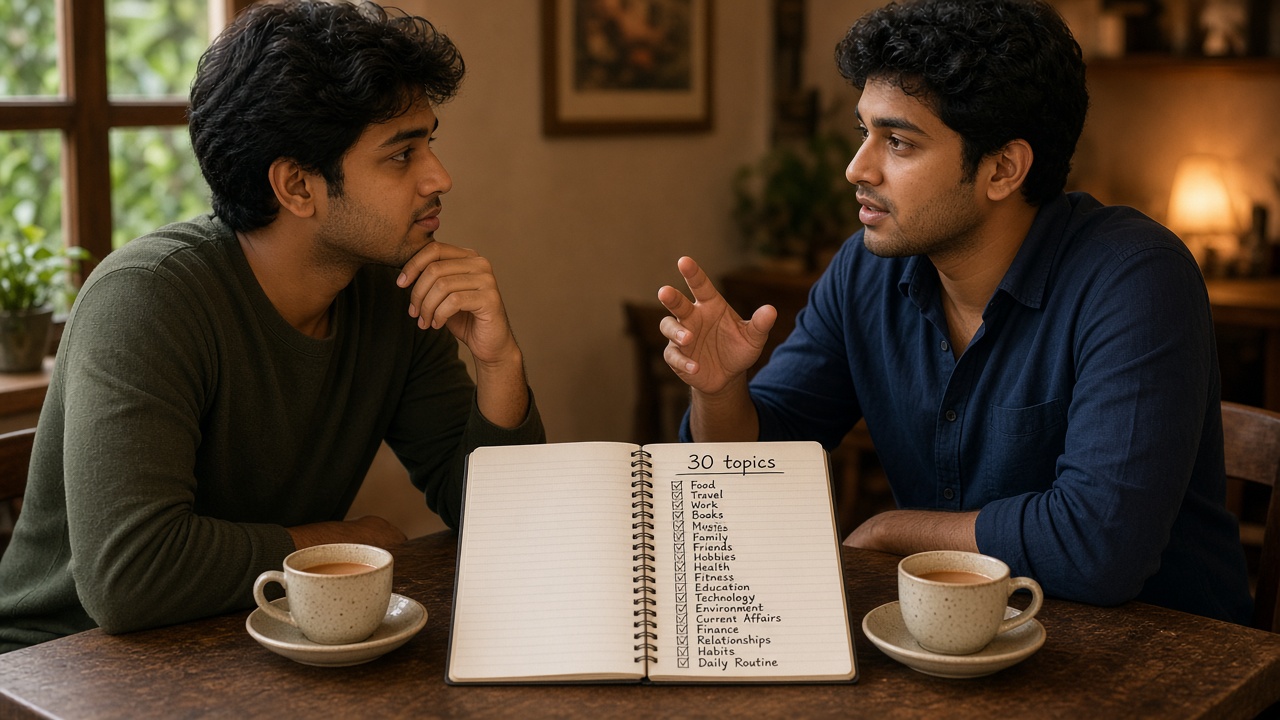
Conversation practice fails when you sit down and cannot think of a topic. Here are thirty. They are ordinary on purpose: food, work, weather, money, family, phones. If you can talk about these, you can talk in class, interviews, and exam Part 1.
Use them with the 25-minute routine from our speaking-skills article, with English Speaking Practice, and in Spoken English batches.
How to use a topic
Two minutes. Frame: opinion or fact, reason, example. Record. Repair five sentences. Do not write a full script first – that is reading practice.
Topics 1–10: daily life
Your morning, a market you use, rain in the hills, a bus or train you take, cooking, neighbours, a festival, sleep, exercise, your phone habits.
Topics 11–20: work and study
Your job or classes, a skill you want, a difficult colleague or classmate, online learning, a deadline, money and saving, uniforms or dress codes, working from home, a teacher who helped you, a mistake you learned from.
Topics 21–30: people and places
A friend, a family elder, Kalka or your town, a place you want to visit, sport, music, news you saw this week, a shop you trust, health, plans for next year.
If a topic is sensitive, skip it and take the next. Practice should be sustainable, not a forced confession.
A month on the wall
Print the thirty topics or copy them into your phone notes. Tick, do not skip around forever. If you skip a sensitive one, tick it as skipped and take the next. At the end of the month you want twenty-five recordings, not thirty perfect speeches. Quantity of honest talk beats a curated three.
Share the list with a classmate and swap one voice note a week. A human ear changes your speed. English Speaking Practice can supply extra angles when a topic is dry.
From topic to grammar
Each topic can carry one rule: yesterday (past simple), plans (going to), people (articles). Write the rule at the top of the note. That is how conversation practice and grammar stop living in different worlds.
A seven-day speaking log (keep it ugly)
Conversation improves when you can point at files, not at intentions. Create a folder on your phone named this week’s date. Each day add one recording, even if it is ninety seconds.
- Mon: routine (present simple).
- Tue: yesterday (past simple).
- Wed: a person you met.
- Thu: an opinion with “because” and an example.
- Fri: shadow 90 seconds of clear audio, then a one-minute talk on the same topic.
- Sat: longer two-minute talk; repair five sentences.
- Sun: listen to Monday vs Saturday. Circle one grammar leak. That leak is next week’s rule.
Bring one file to Spoken English class. Ask for five repairs, not “was it good?” If you cannot attend, send nothing – still do the folder. Fluency is retrieval at home. Class is pressure and correction. Grammar lessons and vocabulary pages on this site support the folder; they do not replace it. When two-minute talks are stable for ten days, you may look at an IELTS or PTE mock. Until then, a mock is an expensive way to learn that you still translate every sentence. We will not pretend a beginner recording is an official English level certificate.
Families: one listener, one job (“Did she use yesterday correctly?”). A committee of six critics will end the week. Put the recorder away if a fight starts; return after tea. The point is a year of speech, not a perfect Sunday.
Today
Number 14: a deadline. Two minutes. Include one past tense and one future sentence. That combination is gold for both life and exams.
Next step. More guided prompts: English Speaking Practice. Live correction: Spoken English Course.
Frequently asked questions
Can I use these for IELTS Part 1?
Yes as fluency training. Real Part 1 questions differ, but the sentences transfer.
Should I discuss with a partner?
If you have one, take one minute each. If not, the recorder is a valid partner.
What if I repeat topics?
Repeating a topic a week later with better grammar is success, not failure.
Exam mock after 30 days?
If two-minute talks are stable, yes – English Mock Test. If not, stay with spoken classes.