
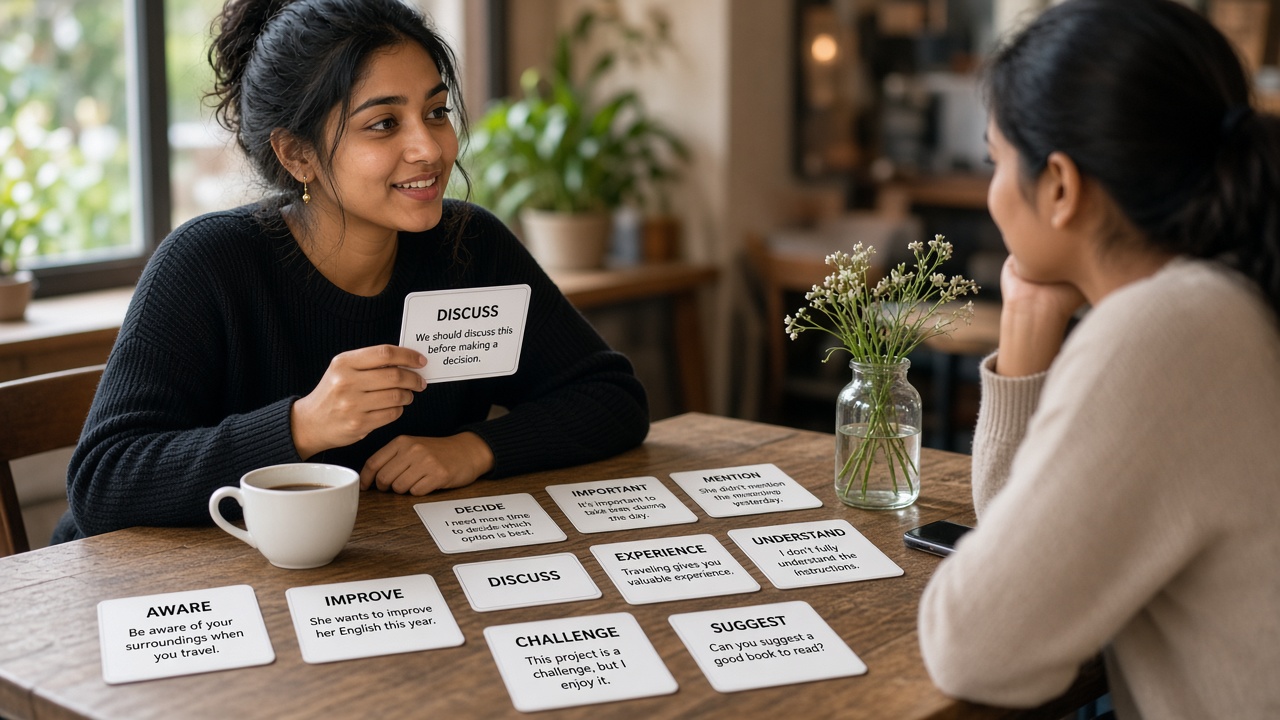
Learners often own three vocabulary notebooks and still freeze when a shopkeeper asks a question. The notebook collected rare words. Conversation needs high-frequency words you can retrieve while looking someone in the eye. That is a speaking problem as much as a memory problem.
Here is a small-set method we use alongside English Vocabulary and Spoken English. Ten words a week, each used in three spoken sentences, beats a hundred unread highlights.
Choose words you will actually say
This week’s theme might be work (“shift,” “deadline,” “cover for someone”), health, or travel. Take words from your real week. If you never discuss astrophysics, do not start there. Exam candidates can add a second mini-set from IELTS/PTE topics later.
The three-sentence rule
For each new word, say: a definition in easy English, a sentence about you, a question you could ask someone. Example – deadline: “A deadline is the last time I can finish work. I have a deadline on Friday. What is your next deadline?” If you cannot do that, you do not own the word yet.
Collocations, not isolated translations
Learn “meet a deadline,” “miss a deadline,” “tight deadline.” One translation in Hindi is not enough. Write the collocation on the card, not only the noun.
Recycle on day 3 and day 7
Without the card, speak for one minute using as many of the ten words as possible. Missing words go back into next week’s set. This recycling is the whole method. Apps that only show flashcards do not force retrieval in a sentence.
A week in the life of ten words
Day 1–2: three-sentence rule for words 1–4. Day 3: one-minute talk forcing those four. Day 4–5: words 5–8. Day 6: mix. Day 7: all ten in a two-minute talk about your actual week. If only six appear, those six are your real vocabulary; the other four return next week without shame.
Families can help: ask a sibling to listen for the week’s words. If they hear none, you stayed in translation. If they hear them stuffed unnaturally, you are performing. Aim for a sentence you would actually say at the chemist.
Where exam lists fit
IELTS and PTE love topic lists: environment, education, health. Add them after everyday sets, or in a second ten if you already speak about your day. Do not replace “receipt” and “queue” with “sustainability” if you cannot buy medicine in English. English Vocabulary classes keep that order on purpose.
A seven-day speaking log (keep it ugly)
Conversation improves when you can point at files, not at intentions. Create a folder on your phone named this week’s date. Each day add one recording, even if it is ninety seconds.
- Mon: routine (present simple).
- Tue: yesterday (past simple).
- Wed: a person you met.
- Thu: an opinion with “because” and an example.
- Fri: shadow 90 seconds of clear audio, then a one-minute talk on the same topic.
- Sat: longer two-minute talk; repair five sentences.
- Sun: listen to Monday vs Saturday. Circle one grammar leak. That leak is next week’s rule.
Bring one file to Spoken English class. Ask for five repairs, not “was it good?” If you cannot attend, send nothing – still do the folder. Fluency is retrieval at home. Class is pressure and correction. Grammar lessons and vocabulary pages on this site support the folder; they do not replace it. When two-minute talks are stable for ten days, you may look at an IELTS or PTE mock. Until then, a mock is an expensive way to learn that you still translate every sentence. We will not pretend a beginner recording is an official English level certificate.
Families: one listener, one job (“Did she use yesterday correctly?”). A committee of six critics will end the week. Put the recorder away if a fight starts; return after tea. The point is a year of speech, not a perfect Sunday.
This week’s ten (adapt if you like)
commute, delay, queue, receipt, appointment, urgent, postpone, reliable, nearby, rather. Apply the three-sentence rule to two words today.
Next step. Theme lists and class practice: English Vocabulary. Speak them in Spoken English. More prompts: English Speaking Practice.
Frequently asked questions
How many words a day?
Two fully owned words beat fifteen half-read ones. Ten a week is a sustainable target for working learners.
Should I learn from the dictionary A–Z?
No. Theme by life and by exam later. A–Z lists die in the bag.
Do I need academic word lists for conversation?
Not first. Academic lists help IELTS/PTE reading. Conversation needs everyday collocations.
Can I mix Hindi in the three sentences?
Use English for all three. If you must, translate only the target word once, then speak English.