
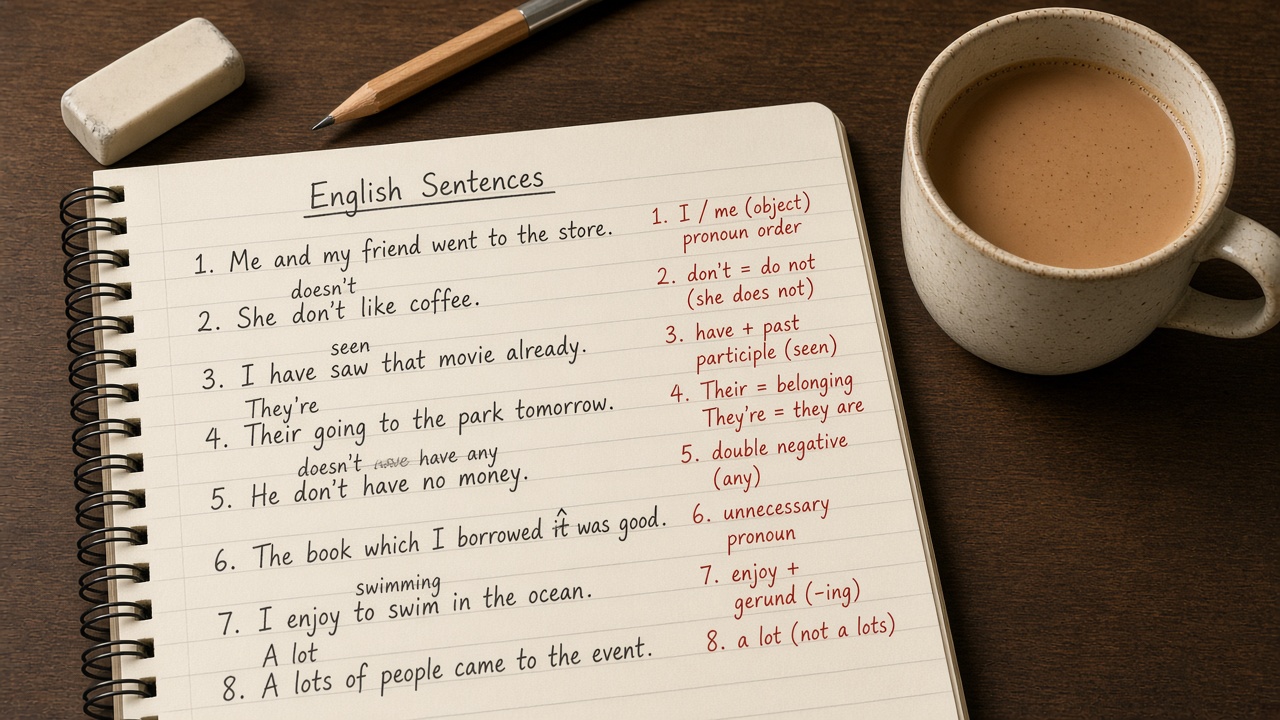
You do not need to eliminate every error to be understood. You do need to kill the errors that repeat in every sentence: tense, articles, prepositions, and word order. Below are twenty mistakes we hear in Spoken English batches in Kalka and online. Read the repair aloud. Do not only highlight it.
Use this list as a week of homework: four items a day, each said in three new sentences. For extra grammar notes, see English Grammar Lessons.
Time and tense
- “Yesterday I go” → “Yesterday I went.”
- “I am live in Kalka” → “I live in Kalka.”
- “Since two years I am working” → “I have been working here for two years.”
- “I will came tomorrow” → “I will come tomorrow.”
- “She didn’t went” → “She didn’t go.”
Articles, nouns, agreement
- “I am engineer” → “I am an engineer.”
- “Informations are” → “The information is.”
- “He don’t know” → “He doesn’t know.”
- “Many staffs” → “Many staff” or “many staff members.”
- “The nature is beautiful” (when you mean nature in general) → “Nature is beautiful.”
Prepositions and set phrases
- “Discuss about” → “Discuss.”
- “Depend of” → “Depend on.”
- “Married with” → “Married to.”
- “Good in studies” → “Good at studies” (and better: “I do well in exams”).
- “On 2024” → “In 2024.”
Word order and false friends
Pick the five items you actually say. Put them on a card on your desk. Speaking improvement is personal, not a longer list.
- “Office in I reached late” → “I reached the office late.”
- “Open the light” → “Turn on the light.”
- “Close the fan” → “Turn off the fan.”
- “I am having 25 years” → “I am 25.”
- “Please do the needful” in a spoken request to a stranger → “Could you help with this, please?” (keep “do the needful” for some Indian office emails if your workplace uses it – not for IELTS).
How to use the twenty without shame
Nobody in class is collecting your mistakes to publish them. We collect them because they repeat. Pick five that appeared in your last recording. Put them on the fridge. For seven days, when you speak at home, glance at the fridge once. That is behaviour change. Reading all twenty every morning and speaking none of the repairs is how the list becomes wallpaper.
If a colleague laughs, you can say you are in an English batch. Most people in this belt have sat in a similar classroom. The laugh is usually recognition, not a verdict.
From repair to a new sentence
A repair is not finished when you nod. It is finished when you use it in a new context. “Yesterday I went” must appear in tomorrow’s talk about the market, not only next to the error on the page. We ask for three new sentences per repair. If that feels slow, good – speaking is slow to rewire and then suddenly it is not.
Bring one repaired set to Spoken English. We will listen for whether the old form still sneaks in under speed.
A seven-day speaking log (keep it ugly)
Conversation improves when you can point at files, not at intentions. Create a folder on your phone named this week’s date. Each day add one recording, even if it is ninety seconds.
- Mon: routine (present simple).
- Tue: yesterday (past simple).
- Wed: a person you met.
- Thu: an opinion with “because” and an example.
- Fri: shadow 90 seconds of clear audio, then a one-minute talk on the same topic.
- Sat: longer two-minute talk; repair five sentences.
- Sun: listen to Monday vs Saturday. Circle one grammar leak. That leak is next week’s rule.
Bring one file to Spoken English class. Ask for five repairs, not “was it good?” If you cannot attend, send nothing – still do the folder. Fluency is retrieval at home. Class is pressure and correction. Grammar lessons and vocabulary pages on this site support the folder; they do not replace it. When two-minute talks are stable for ten days, you may look at an IELTS or PTE mock. Until then, a mock is an expensive way to learn that you still translate every sentence. We will not pretend a beginner recording is an official English level certificate.
Families: one listener, one job (“Did she use yesterday correctly?”). A committee of six critics will end the week. Put the recorder away if a fight starts; return after tea. The point is a year of speech, not a perfect Sunday.
Repair out loud
Record a one-minute talk on “My typical weekday.” Play it and tick any of the twenty errors. Rebuild those sentences and record a second one-minute talk. The second recording is the homework you bring to class.
Next step. Get live correction in Spoken English. Exam path: IELTS Preparation or PTE Preparation. Timed papers: English Mock Test.
Frequently asked questions
Will people laugh if I make these mistakes?
Most listeners care about meaning. These repairs make you clearer and more professional. Practise them for your own standard, not for fear.
Should I stop speaking until grammar is perfect?
No. Speak daily and repair a few items. Silence does not teach speaking.
Are these mistakes only for Indian speakers?
They are common in our classrooms. Other first languages produce other patterns. Bring your recording; we correct what you actually say.
Do IELTS examiners accept Indian English?
They accept clear, accurate English. Some local phrases are fine; missing tenses and articles still cost band score.