
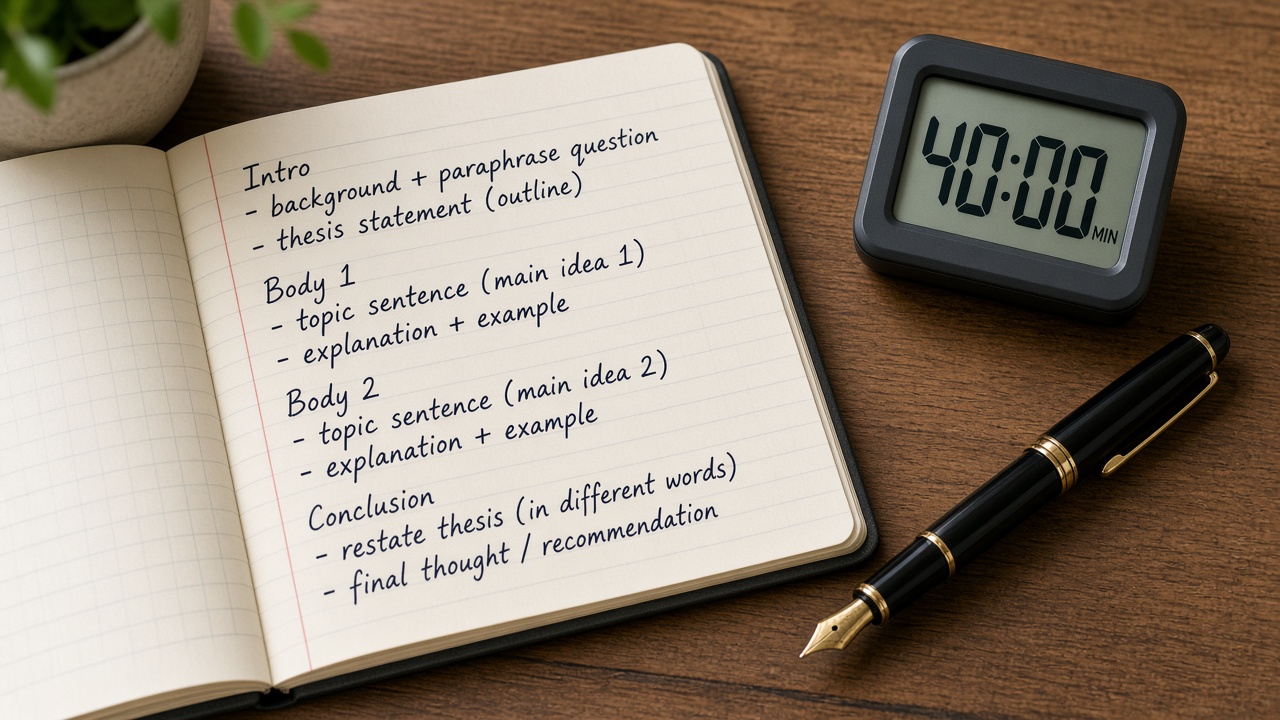
IELTS Writing Task 2 asks for at least 250 words in about forty minutes. Candidates lose marks when they never answer the question, when they write a memorised essay on a neighbouring topic, or when every paragraph is one long sentence. You do not need fancy vocabulary. You need a position, two developed reasons, and a short conclusion.
Here is the structure we drill in IELTS Preparation Online, with a sample outline you can reuse. After you can finish in 40 minutes twice a week, add a full mock from English Mock Test.
Read the task type before you write
Agree/disagree, discuss both views, advantages/disadvantages, and problem/solution are not the same essay. Underline the instruction. If it says “discuss both views and give your opinion,” a one-sided rant fails Task Response. If it says “to what extent do you agree,” sitting on the fence with no position also fails.
A four-paragraph skeleton
Paragraph 1: paraphrase the question and state your position in two sentences. Paragraph 2: strongest reason + example. Paragraph 3: second reason or the other view + your reply. Paragraph 4: two-sentence conclusion that restates the position. That is enough. A fifth paragraph of new ideas usually means you ran out of control.
Question: “Some people think universities should focus on job skills. Others think they should teach academic knowledge. Discuss both views and give your opinion.” Position: universities should keep academic knowledge at the centre and add job skills in the final year – not replace the degree with only training.
Turn the position into body paragraphs
Body 1 (academic knowledge): “A degree should train students to judge evidence. For example, a nursing student who only memorises procedures may struggle when a case does not match the textbook. Academic reading and writing give that flexibility.” Body 2 (jobs, with your limit): “Employers do need graduates who can write an email and work in a team. Internships and a final-year project can teach that without deleting theory.”
Notice the examples are specific but not statistical fiction. Do not invent “a 2019 WHO study of 14 countries” unless you actually know it. Examiners have seen those fake studies.
Language that scores
Use linking that matches logic: however, for example, as a result. Do not begin every sentence with “Moreover.” Mix sentence length. Check articles and subject–verb agreement in the last four minutes – those errors are visible. If grammar is the main leak, support this work with English Grammar Lessons and then write another timed essay.
A full mini-essay you can steal the bones from
Question: some people say children should only study science and maths; others want art and sport as well. Discuss both views and give your opinion.
Intro: Schools are judged on exam results, so science and maths often get the timetable. I agree they are essential, but art and sport should stay in the week because children need more than marks. Body 1: science and maths support jobs and daily problem-solving; a student who cannot handle numbers will struggle in many courses. Body 2: art and sport teach teamwork and attention; in our town, children who only sit at a desk after school burn out before board exams. Conclusion: keep a core of science and maths, and protect a few periods for art and sport rather than deleting them.
That skeleton is 160 words before examples. Add one concrete example per body and you cross 250 without a memorised “in this contemporary epoch.” Write your own examples from school or work. Examiners have met the epoch.
How trainers mark Task 2 here
We check the question type first. Then we look for a visible position, paragraphing, and whether examples are invented studies. Grammar is next, not first. A perfectly punctuated off-topic essay is still off-topic. Bring handwritten or typed essays to IELTS Preparation Online; we will not mark a plan you never wrote in forty minutes.
An eight-day IELTS microcycle you can copy
Use this when the article’s skill is your weak one. Keep the other skills alive with twenty minutes, not another abandoned timetable.
- Day 1: 30 minutes on the skill in this article, timed, no phone.
- Day 2: same skill + 20 minutes Listening (one play only).
- Day 3: Writing Task 2 plan in 12 minutes, or Task 1 if Academic charts are the leak.
- Day 4: Speaking Parts 1 and 2 recorded; repair five sentences.
- Day 5: Reading – one passage with a 60-second map first.
- Day 6: mix the weak skill with a short mock section, not a full paper.
- Day 7: rest the exam brain; ten minutes of spelling or frames only.
- Day 8: repeat Day 1 and compare the recording or the error tally. If nothing moved, change the drill, not only the number of hours.
Working learners should not stack this on top of a full-time job and a six-hour YouTube binge. Cut the binge. Keep the eight days. Shree Academy batches (online and Kalka) exist so Days 4 and 5 have a human listener, but the other days still belong to you. When two microcycles are clean, sit a full paper from the English Mock Test hub and review the same afternoon. Portal bands are practice estimates, never an official IELTS result.
Write the eight days on paper, including the clock time you will actually sit down. A plan that starts “after I feel motivated” does not start. If a festival or night shift destroys two days, skip to the next number; do not hold a funeral for the timetable.
Timed outline (12 minutes, then write if you have 40)
- Pick a Task 2 question from class.
- Write your position in one sentence.
- Write two reason headings and one example each.
- If you have time, write the full essay in 40 minutes and count words.
- Highlight any sentence that does not serve the position – cut or move it.
Next step. Get band-focused feedback in IELTS Preparation Online. A full paper including Task 2 sits inside English Mock Test.
Frequently asked questions
Is 250 words enough?
It is the minimum. Most solid essays land around 270–320. Far beyond 400 often means repetition and more grammar errors.
Can I use “I”?
Yes when you give an opinion. You do not need “the present author believes.”
Should I memorise a full essay?
Memorise structure and frames, not a finished essay. Off-topic memorised scripts score badly.
Academic and GT Task 2 – same method?
Yes, the essay method is shared. GT topics can feel more practical; the marking criteria are still Task Response, Coherence, Lexical Resource and Grammar.